

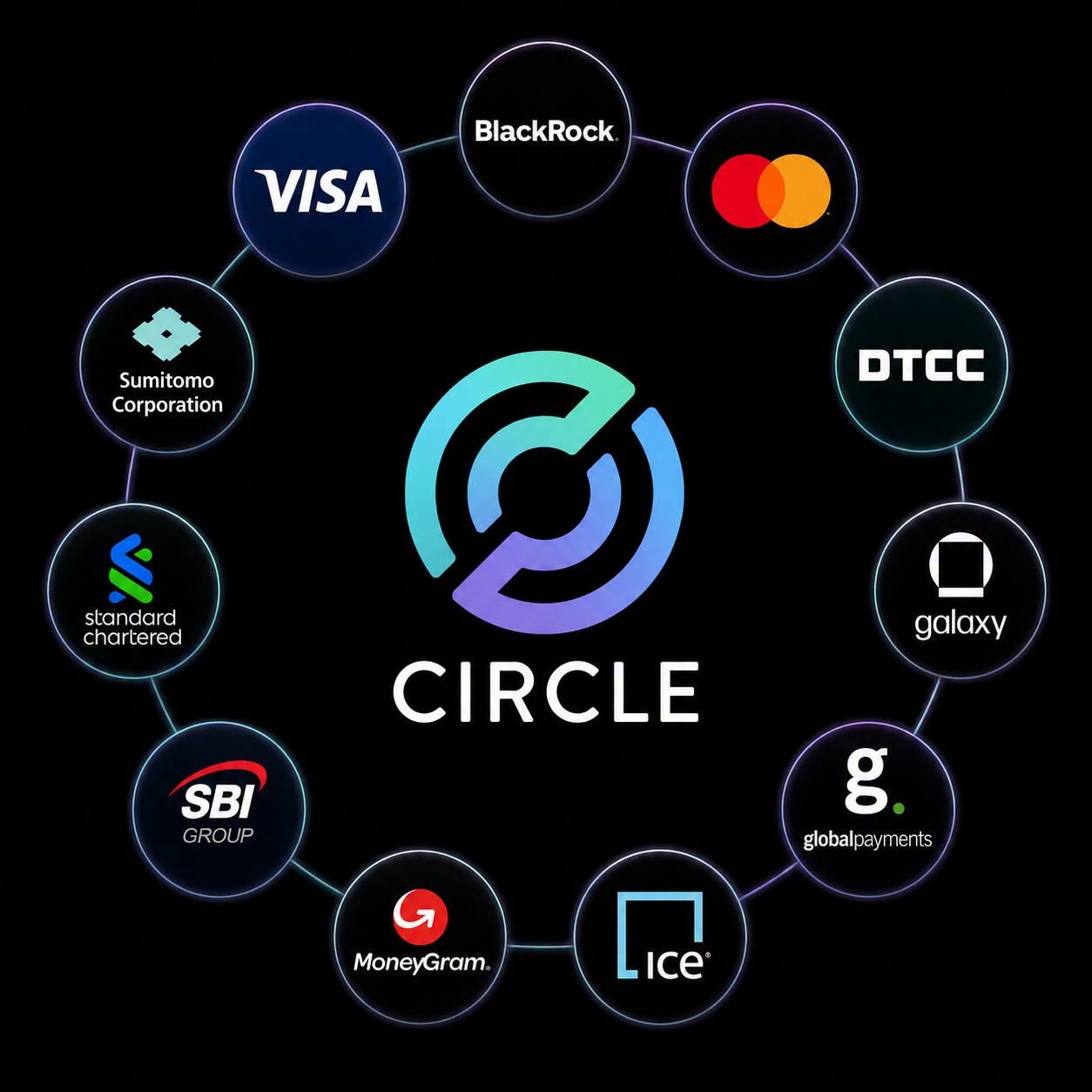
Circle has named Visa, Mastercard and BlackRock among the founding validators for its Arc network ahead of its September mainnet launch. The move brings together some of the world’s largest payments and asset management companies to help secure a blockchain designed for institutional finance and stablecoin infrastructure. By involving established financial institutions from the outset, Circle is signaling that Arc is intended to bridge traditional finance with blockchain-based payments rather than operate as a standalone crypto network. The announcement also highlights growing confidence among major financial firms in tokenized assets and programmable money. As stablecoins continue to move into mainstream payments, partnerships between blockchain companies and global financial institutions are becoming increasingly important. Circle’s latest milestone reinforces its ambition to become a foundational infrastructure provider for the next generation of digital finance.
Video of the Day
Insight of the Day
Agentic AI and the future of B2B payments

B2B payments spans how businesses initiate, authorize, execute and reconcile supplier payments across source-to-pay, AP, invoice processing and treasury controls. In an agentic context, the focus shifts from payment rails to how policies, systems and counterparties govern delegated, machine-executed actions.
Agentic AI adds automation to B2B workflows, but since most corporates still run manual, exception-heavy processes, adoption will be progressive, not uniform. Governance maturity, liability clarity and trust — not model intelligence — will determine how fast organizations delegate execution.
Early adoption will likely concentrate in high-volume workflows like procurement support (supplier matching) and expense management (capture, coding, policy checks, approvals). The best “agent fit” is in the variable parts of a process: unstructured intake, missing context, exceptions, cross-system coordination — while deterministic steps stay rule-based. An agent can read an invoice thread, infer missing cost-center context and propose a coding/approval path, while the ERP still enforces three-way match and approval thresholds.
🔹 Opportunities
Agentic AI reduces friction and cost across three buckets:
Data and intelligence: extract and validate invoice/remittance data, improve AP-ERP consistency, and use propensity signals to prioritize suppliers likely to accept cards. Instead of blanket outreach, an agent flags high-likelihood targets, triggers enablement and monitors acceptance and attrition signals.
Tools and enablers: deterministic controls like rule-based approvals (e.g., auto-approving low-value renewals within threshold) and treasury constraints. Agents triage exceptions and propose actions; systems of record enforce what’s permitted.
Worker agents: reduce coordination overhead in supplier onboarding and routine execution (initiating approved payments, sending remittance, reconciling records) — operating under explicit permissions, thresholds and audit logs, escalating when processes stall or risk increases.
🔹 Risks
Delegated execution changes the risk profile because decisions can propagate across systems faster than traditional workflows:
Control failures — over-reliance creating blind spots or false confidence where human judgment is still needed.
Security and liability exposure — agents acting across platforms increase liability complexity; compromised or “rogue” agents can misuse credentials.
Governance fragmentation — contradictory policies across ERPs, banks and networks can produce inconsistent decisions, and limited explainability makes outcomes hard to justify to auditors and regulators.
The agent-to-agent ecosystem is also still immature — standards are emerging, but without a unified stack, agents built on different frameworks may not interoperate cleanly.
Curated News
💳 Payments
Mastercard and Borderless.xyz Partner on Cross-Border Stablecoin Payments
Mastercard and Borderless.xyz have teamed up to enable cross-border payments using stablecoins. The partnership aims to simplify international money movement by combining blockchain technology with Mastercard’s global payments network.
Source
Mastercard and PEXA Explore Synchronized Property Settlement
Mastercard and PEXA are partnering to explore synchronized settlement technology for UK homebuyers. The initiative aims to reduce settlement risk and improve certainty during property transactions.
Source
Visa Expands Stablecoin Payouts Through Zerohash
Visa is widening its stablecoin payout capabilities by leveraging Zerohash’s infrastructure. The expansion strengthens Visa’s blockchain payments strategy and broadens access to digital asset settlement.
Source
🏦 Banking
Rabobank Commits €2B to AI and Technology
Rabobank will invest €2 billion in artificial intelligence and technology despite stagnant net profit. The investment underscores the bank’s long-term commitment to digital transformation and operational efficiency.
Source
Zaria Applies for U.S. National Trust Bank Charter
Zaria has filed an application with the OCC to establish Zaria National Trust Bank. The move would strengthen its regulated banking capabilities if approved.
Source
UW Credit Union Selects Fiserv’s DNA Platform
UW Credit Union has chosen Fiserv’s DNA core banking platform to support its next phase of growth. The implementation is expected to enhance operational efficiency and member services.
Source
Jamie Dimon Brings Banking and Tech Leaders Together on AI Risk
JPMorgan CEO Jamie Dimon has assembled banking and technology leaders to address the risks associated with artificial intelligence. The initiative reflects growing industry attention on AI governance and operational resilience.
Source
Wells Fargo to Launch Tokenized Deposits for Corporate Clients
Wells Fargo plans to roll out tokenized deposits for corporate customers, expanding its digital asset capabilities. The initiative highlights growing adoption of tokenized banking infrastructure.
Source
💼 Fintech
Maximum Raises $30M to Build an AI-Native Banking Platform
Maximum has raised $30 million to develop an AI-native operating system for banks. The funding will accelerate AI-powered automation and modernization across banking operations.
Source
Cloudflare Gives AI Agents an Identity and Wallet
Cloudflare has launched identity and wallet infrastructure designed specifically for AI agents. The platform enables autonomous AI systems to authenticate and transact securely online.
Source
TS Imagine Brings Prediction Markets Data to Trading Desks
TS Imagine has integrated prediction market data into its institutional trading platform. The enhancement gives trading firms access to alternative market signals alongside traditional financial data.
Source
Yellow Card Raises $40M for Global Expansion
African fintech Yellow Card has secured $40 million in strategic equity funding to accelerate international expansion. The investment supports continued growth of its digital financial services platform.
Source
PalmPay Seeks $200M Funding
PalmPay is seeking to raise $200 million to fuel international expansion and product growth. The fundraising reflects continued investor confidence in African fintech.
Source
🪙 Crypto
Taurus Brings Full Hedera Stack to Global Banks
Taurus has enabled access to the full Hedera technology stack for more than 40 global banks to support digital asset tokenization. The move strengthens institutional blockchain infrastructure.
Source
Ethereum Proposal Would Burn Staking Rewards
A new Ethereum proposal suggests reducing staking rewards to zero if half of all ETH becomes staked. The proposal has sparked debate over network security and long-term incentives.
Source
Ledger Warns AI Is Changing Wallet Security
Ledger says the recent Coldcard exploit demonstrates that Bitcoin wallet security must evolve to address AI-enabled threats. The warning highlights the growing intersection of AI and cybersecurity.
Source
📈 WealthTech
SoFi Expands Private Markets Access
SoFi has expanded access to private market investments through partnerships with CAZ Investments and AngelList Asset Management. The move gives eligible investors broader exposure to alternative assets.
Source
🌍 Other
SoftBank Reports Record First-Quarter Revenue
SoftBank reported record first-quarter revenue, exceeding analyst expectations. The results highlight continued momentum across the company’s technology investment portfolio.
Source
KakaoBank Posts Record First-Half Profit
KakaoBank reported a record first-half profit of $230 million, driven by strong loan growth and higher fee income. The results demonstrate continued strength in South Korea’s digital banking sector.
Source
Disclaimer: Payments Wrap Up aggregates publicly available information for informational purposes only. Portions of the content may be reproduced verbatim from the original source, and full credit is provided with a “Source: [Name]” attribution. All copyrights and trademarks remain the property of their respective owners. Fintech Wrap Up does not guarantee the accuracy, completeness, or reliability of the aggregated content; these are the responsibility of the original source providers. Links to the original sources may not always be included. We use AI tools to brainstorm, draft, edit, and summarize, but the ideas, analysis, and connections Sam draws are his. Every piece is verified and written in Sam’s voice. For questions or concerns, please contact us at sam.boboev@fintechwrapup.com.